
Gentle gym exercises to stay fit after 80 years old are not limited to a few chair stretches. Recent international recommendations outline a precise triptych: moderate endurance, muscle strengthening, and functional balance training. Measuring the gap between this framework and current practices allows for the selection of movements that truly matter at this age.
Balance, endurance, and strengthening after 80: what the data recommends
| Component | Recommended Frequency (WHO) | Main Objective |
|---|---|---|
| Moderate endurance (walking, gentle cycling) | 150 to 300 minutes per week | Cardiorespiratory capacity |
| Muscle strengthening | At least 2 sessions per week | Maintenance of muscle mass and strength |
| Balance and functional strengthening | At least 3 times per week | Fall prevention, preservation of autonomy |
This table summarizes the WHO recommendations, reiterated in syntheses published since 2020 and widely circulated since. Most gentle gym sessions offered to seniors cover flexibility and a few simple movements, but do not connect the exercises to the requirement of three weekly sessions of functional balance.
Many senior programs overlook the endurance component, deemed too ambitious after 80. The data says otherwise: even when broken into short blocks, moderate-intensity activity remains beneficial and achievable.
A comprehensive guide on gentle gym adapted for those over 80 on Seniors des Infos details several movements that fit into this multi-component logic.

Multi-component programs like Otago: why they surpass classic gentle gym
So-called multi-component programs, of which the Otago program is the most documented, combine balance exercises, lower limb strengthening, and regular walking. These protocols have been the subject of numerous clinical studies focused on fall prevention in people over 75.
In contrast, a classic gentle gym session, primarily composed of stretches and light joint mobilizations, does not achieve the same level of functional stimulation. The gap lies in the targeted intensity of balance work and the progression of strengthening.
Key exercises of an adapted multi-component program
- Chair rise without hands (or with light support): targets the quadriceps and glutes, two muscle groups crucial for standing up and climbing stairs. Repeat five to eight times, two to three times a week.
- Heel-to-toe walking over a few meters, with a wall or support bar within reach: dynamically balances work directly related to daily walking.
- Standing plantar flexion (rising on tiptoes) while holding onto a chair: strengthens the calves, muscles often neglected as they stabilize the ankle with each step.
- Lateral weight transfer from one foot to the other, slowly, while standing: engages the stabilizing muscles of the pelvis and reduces the risk of lateral imbalance.
These movements may seem simple. Their effectiveness lies in consistency and progression: adding a repetition, reducing support, slowing down execution. The difficulty should gradually increase every two to three weeks.
Chair-based gentle gym exercises: when to prioritize them and when to move beyond
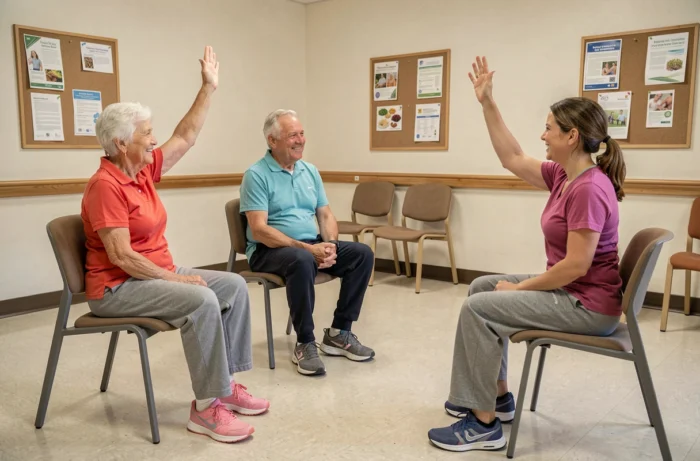
Chair exercises hold a legitimate place for individuals with significant balance issues or marked fatigue. Torso rotations, lateral arm raises with a small water bottle, knee extensions while seated: these movements maintain joint mobility and engage the muscles of the arms, back, and thighs.
Conversely, remaining exclusively seated during each session severely limits the benefits for balance and walking ability. An effective program after 80 includes at least a standing portion with support, even if brief.
Criteria for balancing seated and standing portions
The ability to stand up from a chair without using arm assistance is a simple functional test. If this action is achievable, the session can include a majority of standing exercises with support. If the person needs both hands to stand up, the session starts seated and gradually incorporates one or two standing movements at the end of the program.
The time spent standing can initially be just a few minutes. The goal is not the duration but the consistency of transitioning from sitting to standing.
Sarcopenia after 80: muscle strengthening is not optional
Sarcopenia, or the progressive loss of muscle mass and strength related to aging, accelerates significantly after 80. This phenomenon primarily affects the lower limbs, which explains the deterioration of walking and the increased risk of falls.
Gentle gym alone, when limited to low-resistance movements, is not enough to slow this loss. Two sessions of muscle strengthening per week are the minimum recommended, even at a very advanced age.
No need for expensive equipment. Body weight, a filled water bottle, or a light resistance band provide sufficient resistance to stimulate muscle fibers. The chair rise exercise mentioned earlier already fulfills part of this goal.
Warning signs to watch for
Increasing difficulty carrying a grocery bag, noticeably decreasing walking speed, or trouble getting up from the ground signal a loss of strength that justifies intensifying the strengthening component. Discussing this with a doctor or a professional in adapted physical activity allows for program adjustments without risk.
Fall prevention in individuals over 80 relies on this interplay between balance, strengthening, and endurance. A program that neglects one of these three components leaves a blind spot. Choosing gentle gym exercises with this framework in mind transforms a pleasant session into a concrete lever for maintaining autonomy.