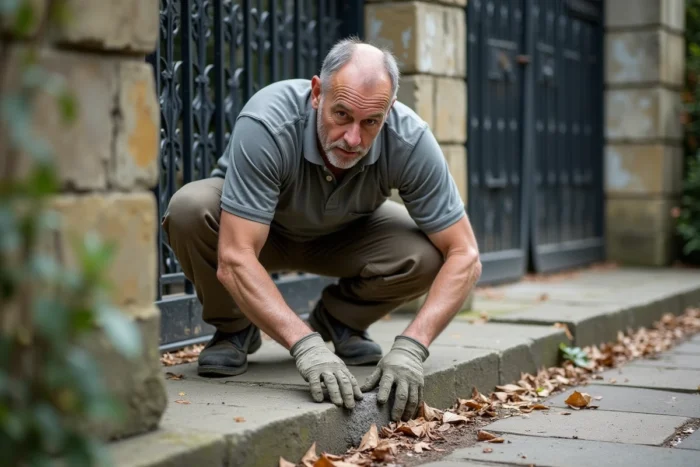
A threshold is a concrete structure cast on the ground, located between the pillars, which serves as a guide for the door leaf and ensures the lower sealing of the entrance. When it cracks, crumbles, or sinks, the gate rubs, gets stuck, or allows runoff water to pass through. The repair involves three distinct operations: removing the degraded concrete, reconstructing the lost volume, and protecting the joint with adjacent surfaces.
Removal and diagnosis of degraded threshold concrete
Before reconstructing anything, it is necessary to remove everything that is no longer stable. The removal involves breaking and extracting pieces of friable concrete, loose chips, and deeply disaggregated areas. A flat chisel and a hammer are sufficient for small surfaces, while a hammer drill equipped with a wide chisel speeds up the work on a severely damaged threshold.
The edges of the purged area should never be beveled. Sharp edges, cut at a right angle, provide much better adhesion for the new mortar than a gentle slope or a conical edge. This detail, often overlooked, makes the difference between a repair that holds and a piece that detaches at the first wheel pass.
The diagnosis also focuses on the depth of degradation. A simple surface flaking (a few millimeters) is not treated the same way as a sinking where the threshold has lost several centimeters in height. In the latter case, additional reinforcement will be necessary to restore rigidity to the structure. To better understand how to recover the threshold according to the extent of the damage, it is essential to classify the repair into one of these two categories first.
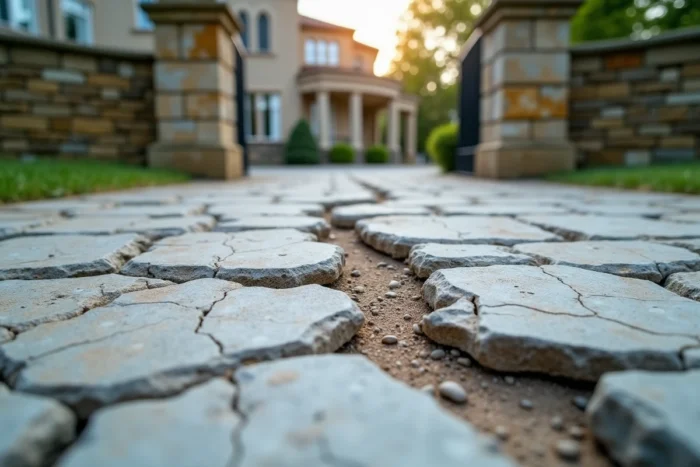
Repair mortar and successive layer pouring technique
The choice of repair mortar directly depends on the thickness to be reconstructed. For repairs less than one centimeter, a fine patching mortar applied with a trowel is sufficient. Beyond that, a structural mortar mixed with coarse sand or micro-concrete provides the necessary mechanical strength to support the weight of the door leaf and the passage of vehicles.
Preparing the substrate before application
Moistening the existing concrete before applying the mortar is a step that repair guides consistently place at the top of the list. The substrate must be moist without standing water, a state sometimes described as “saturated-dry surface.” Dry concrete absorbs water from the fresh mortar too quickly, leading to premature shrinkage and micro-cracking. Conversely, a puddle prevents adhesion.
After moistening, applying a bonding primer (or fluid gobetis) to the walls of the purged area improves the bond between the old and new material.
Fill in layers rather than all at once
A deep repair is filled in several successive layers, each a few centimeters thick. Each layer is compacted with a trowel or smoothing tool to eliminate trapped air pockets in the mortar. Pouring the entire volume at once promotes shrinkage, cracking, and the formation of internal voids.
It is recommended to leave the last layer slightly higher than the final level, then to level it once the mortar is firm enough. This temporary excess compensates for the natural settling of the fresh material.
- First layer: fill the bottom of the cavity and compact well against the side walls to ensure contact with the sharp edges.
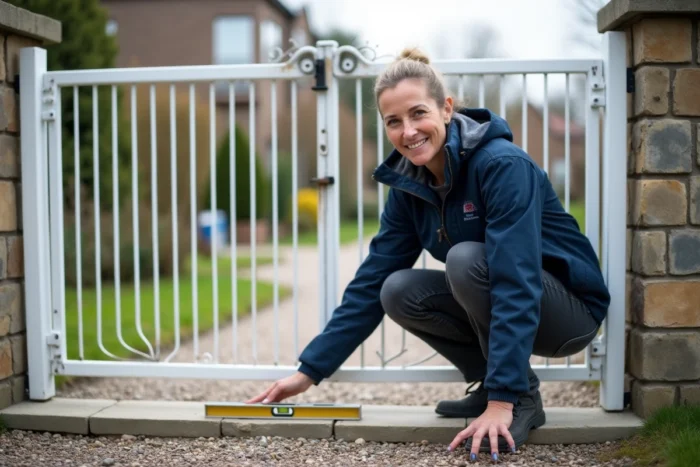
- Intermediate layers: add in regular passes while checking the horizontal level with a mason’s rule or spirit level.
- Finishing layer: smooth with a trowel or float, then level to the desired height after initial setting.
Joint with bitumen and managing the slope around the threshold
The repair of the threshold itself is only part of the problem. The joint between the new concrete and adjacent surfaces (asphalt driveway, slab, embankment) is the most vulnerable area. Job site discussions show that the threshold-bitumen junction is the most frequent breaking point after a repair, especially when the slope has not been properly addressed.
If the driveway is asphalt, a clean cut of the existing bitumen at the threshold before pouring allows for a clean joint rather than a rough overlap. The cut bitumen is then reattached or redone in a narrow strip against the concrete, with a flexible expansion joint between the two materials to absorb differential movements.
The drainage slope deserves special attention. The threshold must remain the high point relative to the driveway to prevent rainwater from pooling against the gate. A slight slope of a few millimeters per meter, directed away from the property, is sufficient to guide the runoff.
Curing the concrete and protecting against the elements after repair
The freshly poured mortar remains fragile for several days. The curing of the concrete involves maintaining a sufficient moisture level at the surface to allow for complete hydration of the cement. Without this precaution, the upper layer dries too quickly, shrinks, and cracks, even if the mixing and application were correct.
The simplest methods work well on a threshold:
- Cover the repair with plastic sheeting held down by stones or battens for the first few days.
- Spray fine water on the surface morning and evening if the temperature exceeds twenty degrees.
- Avoid any vehicle or pedestrian traffic on the repaired area until the mortar has reached sufficient hardness, which usually takes several days depending on weather conditions.
Once the curing is complete, applying a surface water repellent protects the new concrete against freeze-thaw cycles and moisture rising. This treatment is particularly useful on a threshold exposed to the elements and de-icing salt, two factors that accelerate the degradation of concrete.
A well-purged threshold, filled with compacted layers, neatly joined to the surroundings, and protected during its curing retains its strength over the long term. The reinforcement, the sharpness of the edges, and the management of the drainage slope remain the three technical points that separate a durable repair from a mere cosmetic patch.