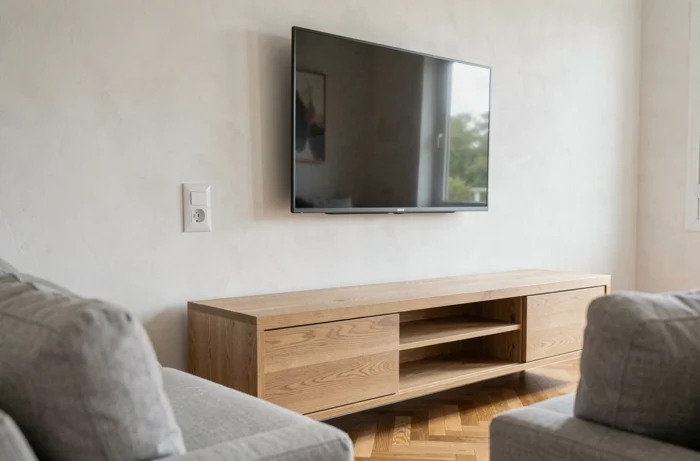
A double wall TV socket combines two coaxial connectors on the same embedded plate: one for the TV signal (DTT or cable), the other for the FM band or satellite. This two-in-one format still equips many homes built before the widespread adoption of fiber optics and internet boxes.
Double coaxial socket and RJ45 communication box: two logics that coexist
The NF C 15-100 standard, in its version applicable from September 2025, directs new installations towards RJ45 sockets connected to a grade 2TV or 3TV communication box. This box centralizes the distribution of telephone, computer, and television signals over structured copper cabling.
The double wall coaxial socket remains compliant with regulations, but it corresponds to an older architecture: one coaxial cable per TV point, wired in a star configuration from a splitter or antenna amplifier. When evaluating the usefulness of a double wall TV socket, the question arises differently depending on whether the home already has a grade 2TV communication box or still operates on a traditional coaxial network.
In a new home wired with grade 2TV RJ45, two RJ45 sockets in the living room can replace the coaxial socket. The TV signal then travels through the structured network, making the double coaxial socket redundant. In an older home without a communication box, the double socket retains its role as the main distribution point.
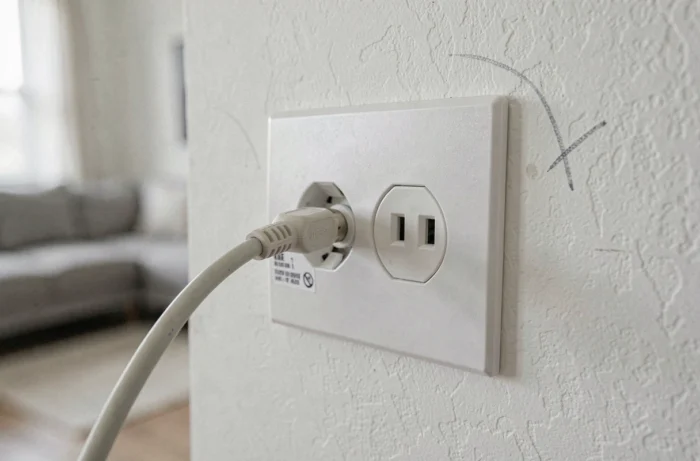
Double TV socket in the living room: cases where it remains relevant
The reception of DTT via a rooftop antenna does not depend on any internet subscription. For households located in ADSL white zones or in areas with insufficient bandwidth for IP television, the coaxial socket remains the only reliable access to terrestrial television.
The second connector of a double socket, dedicated to FM or satellite, also finds its place in specific configurations:
- Satellite reception via an individual dish, when the household receives channels not available via the internet (foreign channels, specific regional offers)
- FM radio listening on a hi-fi tuner connected via coaxial, for a signal quality superior to compressed streaming
- Condominium equipped with a collective antenna with coaxial distribution, where switching to RJ45 would require a renovation of the entire building’s network
In these situations, the double socket is far from superfluous. It avoids the need to pull a second cable or use a T-adapter, which degrades the signal.
TV signal and attenuation: why the connection matters
A T-adapter divides the power of the signal between two outputs, which causes measurable attenuation. On a somewhat older coaxial network or a medium-quality cable, this loss is enough to cause artifacts on the DTT image (pixelation, interruptions). A double socket with integrated filtering separates frequency bands without causing this power division.
The difference is especially felt in homes far from the DTT transmitter, where the signal already arrives weakened. Adding a cheap T-adapter only exacerbates an existing deficit, while a properly wired double wall socket from the splitter maintains a correct signal level on each output.
Double wall TV socket in new housing: an installation losing ground
Recent guides for compliance with NF C 15-100 confirm that at least one TV socket in the living room is still required in new housing. For homes with more than two main rooms, an additional TV point is required in at least two bedrooms, reflecting current multi-screen usage.
The grade 3TV communication box distributes the TV signal over the existing RJ45 network, making coaxial sockets superfluous in a well-designed new installation. The RJ45 cabling offers a practical advantage: each socket can alternately serve for the computer network or television, depending on the configuration chosen at the box.
For a recent television connected to an internet box, the TV signal arrives via the IP network. The wall coaxial socket, whether single or double, simply does not intervene in the reception chain. Installing a double socket in this context amounts to planning for rarely used backup equipment.

Choosing between double TV socket and RJ45 socket: concrete decision criteria
The choice depends on the existing infrastructure and the household’s reception mode. Here are the criteria that guide the decision:
- The home has a grade 2TV or 3TV communication box: the RJ45 socket is sufficient, the double coaxial socket adds nothing
- The home operates on a traditional coaxial network without a box: the double socket remains the simplest solution for distributing TV and FM/satellite without duplicating cabling
- The household receives TV exclusively via an internet box: the coaxial socket (single or double) is unnecessary on a daily basis, but can serve in case of internet failure
- The household uses an individual satellite dish: the second connector of the double socket (SAT input) is then necessary
Renovation or construction: anticipating uses
In heavy renovation with conduit installation, replacing a coaxial network with grade 2TV RJ45 incurs only a marginal additional effort compared to coaxial rewiring. The investment is justified by the versatility of the structured network.
On the other hand, in light renovation where existing conduits require coaxial, installing a double TV/FM-SAT socket remains the most rational choice. Forcing a switch to RJ45 in undersized conduits creates more problems than it solves.
The double wall TV socket is neither a gadget nor a universal standard. Its relevance entirely depends on the type of network in place and the reception mode used. In a home wired with grade 2TV or 3TV RJ45, it is redundant. On an existing coaxial network, with DTT reception via antenna or satellite via dish, it fulfills a technical role that nothing else covers as effectively.